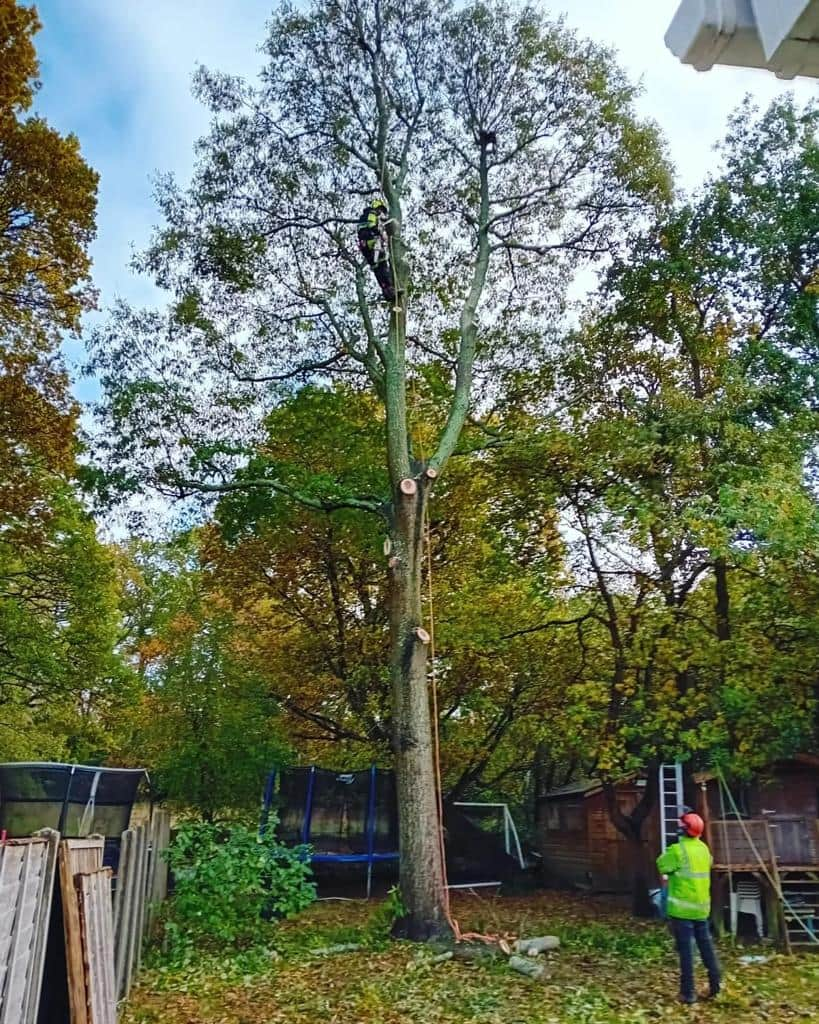
A tree that once fitted comfortably within a garden can become much more dominant as it matures. Its crown may spread across a substantial part of the outdoor space, branches can extend towards frequently used areas, shade may become increasingly noticeable, and routine management can become more difficult. When this happens, homeowners can understandably begin wondering whether removing the tree completely is the only practical option.
In many situations, it is not. Professional tree surgery provides several ways of managing the size, shape and structure of established trees without automatically resorting to felling. Crown reduction, selective pruning, crown lifting and the removal of particular problematic branches can sometimes make a substantial difference while retaining the tree.
For homeowners in Harlow, Essex, the most appropriate solution depends on why the tree has become difficult to manage. Its species, condition, size, structure, surroundings and future growth all need to be considered before deciding whether pruning can resolve the problem or whether felling represents the more appropriate option.
Does an Unmanageable Tree Always Need to Be Felled?
No. A tree becoming large or inconvenient does not automatically mean it needs to be removed.
The first step is to identify exactly what makes the tree feel unmanageable.
If the concern relates primarily to excessive crown spread, low branches, an uneven canopy or particular overextended limbs, targeted tree surgery may provide an effective solution. If the issue involves the condition or fundamental suitability of the complete tree, the options can be different.
Professional assessment helps separate problems that can potentially be managed through pruning from those where retaining the tree may no longer achieve the homeowner’s objectives.
Start by Identifying the Actual Problem
“Too big” can describe several different situations.
One homeowner may be concerned about the overall height of the tree, while another is primarily affected by branches spreading across the garden. In other cases, the problem may be dense shade, low clearance or one particular limb occupying too much space.
These concerns do not necessarily require the same tree surgery technique.
Before recommending work, it is useful to establish precisely what needs to improve. This prevents unnecessary pruning and allows the work to focus on the part of the tree responsible for the problem.
Crown Reduction Can Reduce Overall Dimensions
Crown reduction is one of the main options for managing a tree that has become disproportionately large for its surroundings.
The technique involves selectively shortening branches throughout part or all of the canopy, reducing its height, spread or both.
A professional crown reduction is not simply cutting the tree back to an arbitrary line. Branches are shortened to appropriate growth points so that the remaining canopy retains a suitable structure and natural appearance.
Where the tree is otherwise suitable for retention, this can make it considerably easier to accommodate within the garden.
A Modest Reduction Can Sometimes Make a Significant Difference
It is not always necessary to remove large amounts of growth to achieve a useful result.
Reducing selected outer branches can sometimes create noticeably more space around an established tree.
This is particularly relevant where the problem is caused by the outer extent of the crown rather than the complete tree.
A proportionate approach also retains more healthy foliage and avoids altering the canopy more severely than necessary.
The objective should be to achieve a practical improvement rather than simply remove the maximum amount of growth.
Selective Pruning Can Target Individual Problem Branches
Sometimes the tree itself is not genuinely unmanageable; one or two branches are creating most of the difficulty.
A long lateral branch may extend across a large section of the garden, for example, while the remainder of the crown fits comfortably within the available space.
Selective pruning can address these specific branches without substantially changing the rest of the tree.
This can be particularly useful where the homeowner wants to retain the tree’s overall size and character while resolving a localised problem.
Crown Lifting Can Improve Space Beneath a Tree
Where lower branches are the main concern, crown lifting may be more appropriate than reducing the complete canopy.
Crown lifting involves removing or shortening selected lower branches to increase clearance beneath the crown.
This can make movement around the tree easier and improve the usability of the space underneath it.
The technique does not necessarily reduce the tree’s overall height, so it is most relevant where low growth rather than upper crown size is causing the problem.
More Light May Be Achievable Without Felling
Dense shade is a common reason homeowners begin considering tree removal.
However, felling is not automatically the only way to improve light.
The most appropriate pruning technique depends on which part of the crown is creating the shade and where additional light is wanted.
Selective pruning or an appropriate crown reduction may sometimes improve the relationship between the tree and surrounding garden.
The direction of shade and position of the relevant branches should be considered rather than simply removing large amounts of foliage indiscriminately.
More Pruning Does Not Always Produce More Light
It can be tempting to assume that heavily reducing a tree will automatically create the brightest possible garden.
The relationship is not always that simple.
Removing growth from sections that have little influence on the area being shaded may provide limited practical improvement. Some trees can also respond to heavy pruning with vigorous regrowth.
A targeted approach considers which branches are actually responsible for the unwanted shade.
This can achieve a more useful result while retaining an appropriate crown.
An Uneven Crown Can Often Be Managed
Trees do not naturally develop perfectly symmetrical canopies.
Available light, surrounding features, previous pruning and branch loss can all influence their shape.
However, one part of a crown can occasionally become particularly dominant or extended.
Selective reduction may help improve the proportions of the tree without attempting to create artificial symmetry.
The objective is to manage excessive growth while respecting the natural form of the species.
Previous Branch Loss Can Change How a Tree Develops
A tree that has previously lost a substantial branch may develop differently afterwards.
Remaining branches can become more visually dominant, while new shoots may develop around the affected area.
Over time, the resulting crown can appear increasingly awkward or unbalanced.
Before deciding that such a tree has become unmanageable, its previous damage and subsequent growth should be assessed.
Careful pruning may sometimes improve the crown without requiring complete removal.
Deadwood Can Make a Tree Appear in Worse Condition
A mature tree containing several dead branches can look significantly deteriorated from ground level.
However, deadwood within the crown does not automatically mean the complete tree requires felling.
Where the underlying tree remains suitable for retention, dead branches can often be removed selectively.
This can improve the appearance of the canopy and deal with specific deteriorated branches while preserving healthy growth.
The wider condition of the tree should determine whether more extensive work is necessary.
Tree Species Influences the Available Options
Different tree species have different natural growth habits and responses to pruning.
Some tolerate particular forms of reduction more readily than others, while certain trees produce substantial regrowth following heavy pruning.
This means an appropriate management plan cannot be based on size alone.
The species needs to be considered alongside the condition and structure of the individual tree.
Professional tree surgery adapts the pruning approach to the tree rather than attempting to apply the same reduction to every canopy.
The Tree’s Condition Matters as Much as Its Size
A large tree and a deteriorating tree are not necessarily the same thing.
Size alone does not determine whether a tree should be retained or felled.
Before deciding on the work, the crown, main stem, significant branch unions and other relevant structural features should be considered.
Where the tree is in suitable condition and the main problem is its dimensions, pruning options may be available.
Where significant deterioration is present, the decision may require a different approach.
Repeated Heavy Pruning May Not Be a Good Long-Term Strategy
Some trees become trapped in a cycle of substantial pruning followed by vigorous regrowth.
The tree is heavily reduced because it feels too large, then produces new growth that eventually recreates the original problem.
Repeated severe pruning may therefore provide limited long-term benefit.
A more considered management plan looks at how the tree is likely to respond and whether a moderate reduction can be maintained sensibly.
Where the tree will continually conflict with the available space despite appropriate management, its longer-term suitability may need to be considered.
Future Growth Should Be Part of the Decision
Tree surgery should not focus only on how the tree will look immediately after the work.
Trees continue growing.
A pruning plan should therefore consider how the remaining crown is likely to develop over the following years.
Understanding future growth can help determine whether crown reduction offers a practical management solution or merely postpones the same difficulty for a short period.
This longer-term perspective is particularly useful when deciding between continued management and felling.
Excessive Pruning Can Be Counterproductive
If a tree has become inconvenient, removing a very large proportion of its crown can seem like an attractive compromise between leaving it alone and felling it.
However, excessive pruning is not necessarily beneficial.
Healthy foliage plays an important role in the tree, and severe removal can significantly alter its structure and response.
In some species, heavy cutting can encourage vigorous new shoots.
Professional tree surgery aims to achieve the required improvement while avoiding unnecessary removal of healthy growth.
Topping Is Not the Same as Professional Crown Reduction
Indiscriminately cutting the top and ends from major branches should not be confused with a properly planned crown reduction.
Professional crown reduction works selectively through the canopy and uses appropriate pruning points.
The aim is to retain a coherent branch framework rather than leave large stubs or an abrupt outline.
When managing an oversized tree, the quality and method of pruning matter just as much as the amount removed.
The Surrounding Garden Should Be Considered
A tree does not exist independently of the space around it.
Its relationship with lawns, paths, seating areas and other parts of the garden can influence whether it remains practical.
Sometimes changing the dimensions of one section of the crown is enough to improve this relationship.
In other situations, the tree may occupy such a substantial proportion of the available space that repeated management provides diminishing practical benefit.
Assessment should therefore consider both the tree and how the homeowner needs to use the surrounding garden.
A Tree Can Be Retained at More Manageable Dimensions
For suitable trees, periodic professional pruning can form part of a longer-term management approach.
Rather than waiting until the canopy becomes overwhelmingly large, future work can be planned around how the tree responds to the initial reduction.
This does not mean fixing the tree permanently at one exact size.
It means managing its development in a way that remains appropriate for the species and surroundings.
For homeowners who value an established tree, this can provide a practical alternative to immediate removal.
When Might Felling Become the More Appropriate Option?
Although pruning can solve many problems, there are situations where felling may need to be considered.
The decision should be based on the individual circumstances rather than simply the fact that the tree is large.
Factors that may influence the discussion include:
- The tree’s overall condition
- Significant structural deterioration
- Extensive damage that cannot reasonably be addressed through selective pruning
- Repeated management failing to achieve a practical result
- The tree remaining fundamentally unsuitable for the available space
- The homeowner’s objectives being impossible to achieve through proportionate pruning
- Severe decline affecting substantial parts of the tree
These factors require proper assessment. One feature alone does not automatically determine that felling is necessary.
Felling Should Not Be the Default Response to Size
A large mature tree can appear overwhelming, particularly if it has not been managed for many years.
However, visual size alone provides limited information about the available options.
An assessment may reveal that only certain branches are causing the practical problem.
Where this is the case, targeted tree surgery can provide a less extensive solution.
Starting with the actual cause of the problem helps avoid removing a tree when proportionate management could achieve the desired improvement.
Equally, Pruning Should Not Be Recommended Without a Purpose
Retaining a tree is not automatically the correct answer in every situation either.
Tree surgery should have a clear objective.
Repeatedly pruning a tree without achieving a useful long-term result can become an ineffective management strategy.
A professional assessment should therefore consider both retention and removal objectively, with recommendations based on the tree’s condition, characteristics and surroundings.
Can Several Tree Surgery Techniques Be Combined?
Yes. An unmanageable tree may have more than one issue.
For example, the overall crown may require a modest reduction while selected lower branches also require attention.
In another case, deadwood removal may be combined with selective reduction of one overextended section.
The techniques should complement each other rather than simply increasing the amount of growth removed.
A planned approach allows each cut to serve a specific purpose.
What Should Be Assessed Before Deciding?
Before deciding whether to prune or fell an unmanageable tree, several factors are worth considering:
- Tree species
- Overall condition
- Crown dimensions
- Branch structure
- Dead or damaged growth
- Previous pruning
- Previous branch failures
- The specific parts causing difficulty
- The amount of usable garden space
- The desired outcome
- Likely future growth
- How the tree may respond to pruning
Considering these factors together provides a much stronger basis for deciding what work is appropriate.
Why Professional Tree Assessment Is Valuable
Homeowners can usually explain what they dislike about an overgrown tree, but identifying the most appropriate pruning method requires a closer understanding of its structure.
Professional assessment can establish whether the concern relates to the whole crown or only particular branches.
It can also determine how much reduction is appropriate and whether the tree is likely to respond well to the proposed work.
This allows recommendations to remain proportionate, retaining healthy growth where possible while still addressing the practical reason tree surgery is being considered.
Tree Surgery in Harlow, Essex
At Harlow Tree Surgeons, we assess established trees individually before recommending crown reduction, selective pruning, crown lifting, deadwood removal or felling.
Where a tree has become difficult to manage, the first objective is to understand why. Its size, condition, branch structure and relationship with the surrounding garden can then be considered alongside what the homeowner wants to achieve.
For homeowners in Harlow, Essex, this approach helps determine whether professional pruning can make the tree more manageable or whether removal represents the more appropriate long-term solution.
Conclusion
Felling is not the only solution when a tree has become unmanageable. Crown reduction, selective pruning, crown lifting and the removal of specific problematic branches can often make an established tree easier to accommodate while retaining its character and healthy growth.
The correct option depends on why the tree has become difficult to live with. Its species, condition, crown structure, surroundings and future development all influence whether pruning can provide a practical long-term result. In some situations felling may ultimately be appropriate, but it should not be assumed simply because a tree has become large.
If you have a tree that has become difficult to manage at your property in Harlow, Essex, contact Harlow Tree Surgeons to arrange a professional assessment. We can examine the tree, discuss what you would like to achieve and determine whether targeted tree surgery or felling is the more suitable approach.
Call us on: 01279 969 199
Click here to find out more about Harlow Tree Surgeons
Click here to complete our contact form and see how we can help with your tree care needs.